THE TEST THAT MIGHT START A TINY COUPLE’S CRISIS 😂
There’s a question that sooner or later comes up in every home where two people and a dog live together:
«But… who does he love more?»
You both say it makes no difference to you. That the dog belongs to both of you. That love can’t be measured. That there’s no competition at all.
Lies.
You both notice who gets the first greeting when you come home. Who he looks for when he’s scared. Which side of the bed he sleeps on. And, above all, what happens when you both call him at the same time.
Because we can be sensible, emotionally balanced adults… until our dog chooses to sit next to the other person. 😂
I’ve always been crystal clear about this
Of all the dogs who have passed through Mas Torrencito, every single one has been mine.
They’ve all loved me more. Or, at the very least, they’ve all known perfectly well who the pack leader was.
Manuela was mine. Don Markos was mine. Mastitwo is mine. Mamas is mine. Even the ones who could split their attention knew that, when it came down to it, I was the center of the universe.
All of them.
EXCEPT ONE.
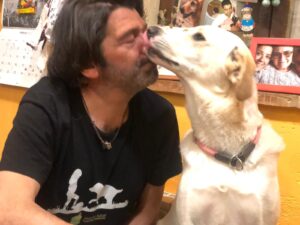
Masto belongs to Mireia. It’s that simple.
It’s not that we don’t get along. It’s not that he doesn’t love me. He respects me, he’s fond of me, and if Mireia isn’t around, I can pass as reasonably acceptable company.
But the moment she shows up, it’s over.
He only has eyes for Mireia. He follows her, watches her, waits for her, chooses her. If the two of us were hanging off a cliff and Masto could only save one, I’d spend those last few seconds saying my goodbyes. 😂
And no test is going to change that.
Do dogs really love one person more?
There’s no scientific «love-o-meter» that can tell you your dog loves you 63% and your partner 37%. And dogs don’t always hand every important role in their life to a single person, anyway.
They might look for one person when they need security and a different person when they want to play. They might obey whoever sets boundaries best, sleep next to whoever radiates calm, and beg for food from whoever has a worryingly generous hand with the ham.
What science has actually found
No researcher can sit your dog down in front of a screen and ask him to rate the family members. But we do know that a dog’s bond with the people in his life leaves observable traces.
Your dog may use you as a «secure base»
In 2013, a team at the University of Veterinary Medicine Vienna gave several dogs a task involving objects they had to manipulate. The dogs kept trying for longer when their owner was present, whether that owner was encouraging them or just staying quiet. When the owner was replaced by a stranger, the effect disappeared.
Researchers called this the «secure base effect»: the presence of the attachment figure gave the dog the confidence to explore and tackle the task. In other words, sometimes he isn’t proving you’re his favorite person by jumping all over you — he’s proving it by feeling braver when you’re around. See the study by Horn, Huber and Range.
Eye contact builds bonds too
Another study, published in Science in 2015, observed an oxytocin-related loop during interactions between dogs and their owners. Longer gazes from the dog were linked to rises in oxytocin in their person, and within the experiment, that interaction could in turn reinforce the dog’s own response.
That doesn’t mean every time your dog looks at you he’s reciting a love poem. He might just be waiting for you to open the fridge. But it does give a biological basis to something we all recognize: looking at each other, touching, and interacting strengthens the bond. See the study by Nagasawa and colleagues.
But the choice can depend on the moment
And here comes the detail that might save a relationship: a choice experiment published in 2017 found that dogs don’t always automatically prefer their owner. Context, location, how long the interaction lasts, and familiarity can all change who they go to.
So a single scene doesn’t settle the case. If he ran to your partner today, it might mean love… or it might mean you’ve been on the sofa for two hours and she just walked in with a bag. See the study on choice and context.
At Mas Torrencito we’ve already touched on another part of this story: science has found similarities between some dogs and their owners, both physical and in personality. Maybe we don’t just end up looking alike — maybe we also learn to seek each other out in different ways.
That’s why this test doesn’t just try to find out who he picks most. It also looks at what he picks each person for:
- Attachment: who he follows, waits for and seeks out on his own.
- Security: who he turns to when he’s scared, hurt or unsure.
- Fun: who he looks for to play, go for walks and throw a party.
- Self-interest: who hands out treats, opens doors, and handles the food situation.
The ultimate test: who does he love more?
Think about what he normally does, not what you’d like him to do.
You missed a question. Your dog demands a complete test before he’ll rule. 🐶
Before you get upset about the result…
If your dog picks someone else more often, it doesn’t mean you’re not important. Sometimes the favorite person to rest with isn’t the favorite person to play with. Whoever gets the loudest welcome-home party might not be the one offering the most security. And whoever gets all the stares in the kitchen might owe their success to less-than-romantic reasons.
There are also dogs who split their love with admirable precision: one for walks, another for naps, and both for showing up instantly the moment they feel they’ve gone too long without attention.
But let’s be honest: if you both call him and he always runs to the same person… there’s definitely a clue in there. 😂
Frequently asked questions about a dog’s favorite person
Can a dog love one person more than another?
He can show a stronger preference for one person, especially through behaviors like following them, seeking their contact, relaxing next to them, or going to them when he feels insecure. But «preferring» doesn’t mean he doesn’t keep important bonds with everyone else.
Does a dog love whoever feeds him more?
Food helps build positive associations, but attachment doesn’t depend on the bowl alone. Cohabitation, security, the quality of interactions, play, and the ability to understand his signals all play a part too. Some dogs adore whoever hands out the treats and seek comfort from someone else entirely.
Why does my dog always follow my partner and not me?
He might feel especially secure with them, anticipate fun activities with them, or have simply turned that following into a routine. Following someone doesn’t automatically mean loving them more, either. If your dog tags along to the most private room in the house, here’s why your dog follows you to the bathroom.
Why does he obey me but seek affection from the other person?
Because obedience and attachment aren’t exactly the same thing. He may have associated you with clear instructions and turn to the other person to relax or get physical contact. That’s exactly why the test separates security, fun, attachment and food.
I just adopted my dog: can I already tell who his favorite person is?
It’s too soon to say for sure. A newly arrived dog can be shut down, confused, or still learning the routines. His behavior can change a lot as trust builds. The 7-7-7 rule for adopted dogs helps explain why it’s best not to draw conclusions in the first few days.
Do licks prove who his favorite person is?
Not necessarily. Licking can be part of an affectionate greeting, but it can also come from excitement, attention-seeking, taste, or even discomfort. If there’s a kissing specialist in your house, you can also put him through our Lick-o-Meter.
Now we want to know the truth
Take the test, share the result with your partner, and tell us in the comments:
Did the winner turn out to be who you expected… or has a family crisis just started?
And if you dare, write your dog’s name and the percentage each of you scored. No judgment here. Except, maybe, for whoever had spent years insisting they were the favorite. 🐾
Mas Torrencito — Parets d’Empordà, Girona. La primera casa rural para mascotas que acepta personas.