
Does Your Dog Love You… or Try to Exfoliate You?
The science of dog licking, explained without putting you to sleep, with a test at the end.
There are dogs that give you a little kiss. There are dogs that lick your hand. And then there’s Masto.
Masto doesn’t lick. Masto tries to remove your first layer of skin.
If you’re not careful, he starts with a hand, moves up the arm, finds a bit of leg, and it already feels like a free exfoliation session.
And we’re not talking about three licks. No. He can be licking, licking, licking, and licking as if he’d signed a contract obligating him to leave you perfectly polished before going to sleep.
Or keep reading — the science is addictive too, we promise
For a long time I thought:
«This dog is a pain.»
Then I thought:
«This dog loves me so much.»
And then the interesting question showed up:
Why on Earth Do Dogs Lick Us?
Are they really kisses? Is it affection? Do they like our taste? Are they seeking our attention? Does it calm them down? Or do some of us have a little tongue psychopath living at home?
The scientific answer turns out to be much more interesting: it can be several of these things at once.
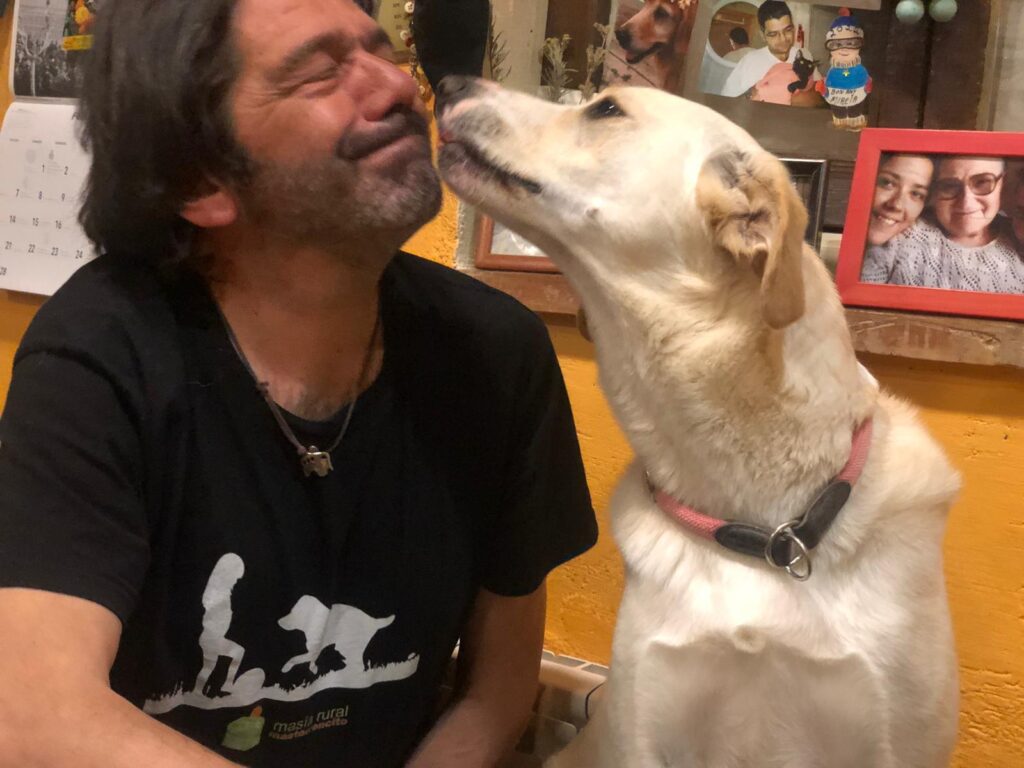
First: Is a Lick Really a Kiss?
Not exactly. We humans decided to call licks «kisses» because it’s a fairly convenient translation. But licking has been part of dogs’ social repertoire long before we showed up saying: «Aww, he’s giving me kisses.»
Dogs use their mouth, snout, and tongue to interact with their environment and with other individuals. That’s why a lick can mean very different things depending on the moment. It can be:
- social contact,
- a greeting,
- attention-seeking,
- excitement,
- learned behavior,
- appeasement,
- self-regulation,
- or simply a behavior the dog finds pleasant.
And here’s where it gets good.
Your Dog May Lick You Because He Likes Being With You
This is the explanation we all wanted to hear. Yes. The affective component is real.
In 2017, dogs that spent ten minutes in friendly interaction with humans showed an average increase of 39% in salivary oxytocin, and the ones that licked, played, and sought physical contact the most were also the ones whose levels rose the most. In 2015, another study published in Science found something similar in the other direction: simple eye contact between dog and owner triggered oxytocin in both, a positive dog-human loop.
That doesn’t mean lick = oxytocin = love — science is rarely that simple — but it does mean your dog has a whole biological system ready to build powerful social relationships. And we’re part of them. That seems a lot nicer to me than just saying «he licks you because you taste salty» 😂
But He Could Also Be Saying: «HEY. LOOK AT ME.»
We all know this part. Your dog comes over. Lick. You don’t react. Another lick. Still nothing. LICK. You look at him. Jackpot. He just got exactly what he wanted.
Dogs are extraordinarily good at detecting which behaviors get a response from us. Other experiments have shown they adjust their behavior to get our attention, even depending on whether we’re looking at them or not. And we cooperate a lot.
Even if you push him away, laugh, talk to him, or pet him while telling him to stop, you’ve interacted with him. For some dogs, that’s already reward enough. And that’s how a lovely vicious cycle can form: I lick → the human reacts → I lick again.
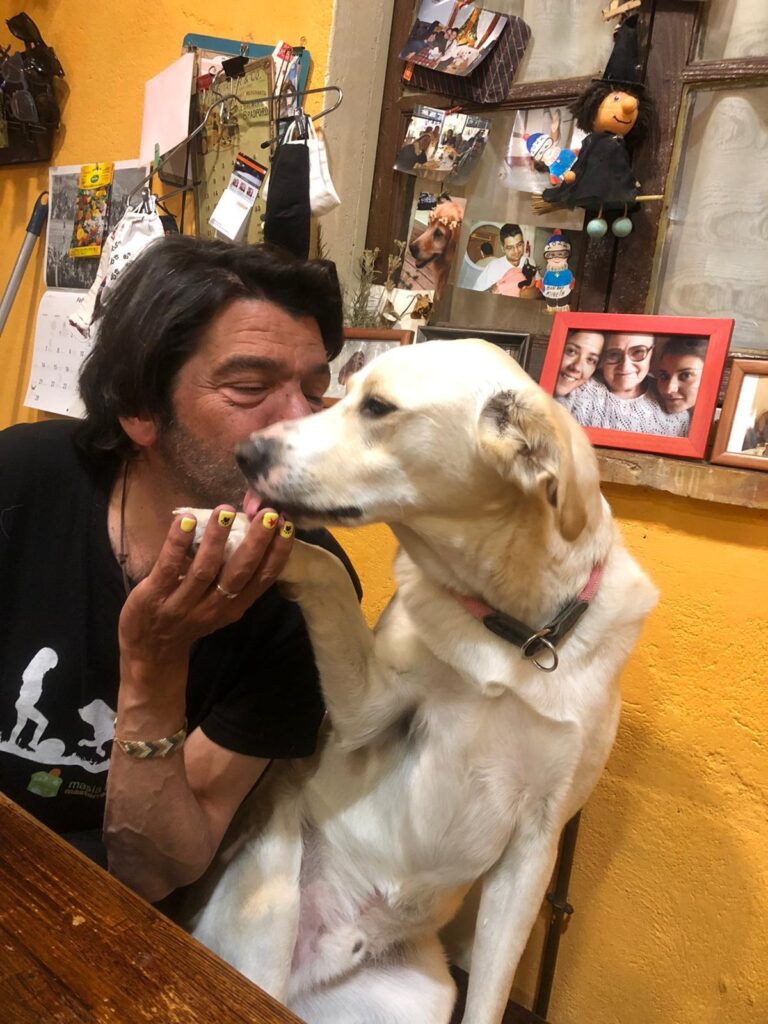
It Can Also Be a Way of Greeting You
A study of 116 dogs analyzed behaviors like looking away or licking their lips during encounters with people. Lip licking showed up, among other situations, as part of greeting behavior and certain appeasement signals.
That’s why some dogs seem especially «licky» when you get home, when you wake up in the morning, when you sit down next to them, when you return after being away, or when a very intense interaction begins. It’s their own version of GOOOOOD MORNIIIING 👅👅👅👅👅
But Careful: Not Every Lick Means Happiness
A dog can also lick its lips when it’s uncomfortable, insecure, or stressed. In fact, lip licking shows up repeatedly in studies on canine stress. During vet exams, for example, an increase in this behavior has been observed alongside other physiological signs of stress. A study published in 2026 again found lip licking among the frequent stress behaviors during a vet visit.
That’s why we should never interpret an isolated gesture. You have to look at the whole dog. It’s not the same to see:
🐶 relaxed body + calm tail + voluntary approach + licking + desire for contact
as:
🐶 rigid body + ears back + head turning away + yawning + rapid lip licking + attempt to move away
The tongue might be doing something similar. The dog isn’t necessarily saying the same thing.
So When Does It Stop Being «My Dog Is Just Affectionate»?
A dog can be tremendously licky and be perfectly fine. But a repetitive behavior that takes up a huge amount of time, seems impossible to interrupt, appears out of context, interferes with sleeping, playing, or resting, is compulsively directed at the dog itself, people, surfaces, or objects, or suddenly appears when it didn’t exist before, deserves closer attention.
The Merck Veterinary Manual lists excessive licking among the behaviors that can appear in compulsive disorders when they’re repetitive, exaggerated, and hard to interrupt. And that’s no longer territory for our online test — that’s when you talk to a vet or a behavior professional.
Are Some Breeds Lickier Than Others?
Here comes a small disappointment. We would have loved to publish «GOLDENS LICK 87% MORE THAN GREYHOUNDS.» Problem: it’s not true.
There’s no serious scientific classification that lets us claim a given breed will «give you more kisses» than another. A huge study published in Science analyzed behavioral data from 18,385 dogs and genetics from more than 2,000. The result? Although there are hereditary components in various behaviors, breed explained only about 9% of the behavioral variation between individuals.
That’s why our test is going to ask you the breed. Because we want to know it. Because it’s fun. Because we’ll be able to compare results. But we’re not going to decide your dog is a skin-destroying menace just because he’s a Labrador. What actually matters here is what your dog really does.
🧪 THE MAS TORRENCITO LICK-O-METER™
Science got us this far. We’re going a little further 😂
Answer a few questions and our highly sophisticated dog-science system will analyze how much he licks, for how long, when he does it, where he licks you, whether he accepts an «okay, that’s enough,» whether he does it to get attention, and whether you’re living with a normal dog or a pressure washer on legs.
We already know who wins in our house. Masto plays in a different league. But we want to check if there’s any competition out there.
Take the test and tell us in the comments: what’s your dog’s lickiness percentage? And, above all… is anyone capable of beating Masto? Because if a 100% MASTO LEVEL shows up, we want proof 😂🐶👅
📚 Scientific Sources Used
- MacLean, E. L. et al. (2017). Effects of Affiliative Human–Animal Interaction on Dog Salivary and Plasma Oxytocin and Vasopressin. Frontiers in Psychology, 8:1606. View study
- Nagasawa, M. et al. (2015). Oxytocin-gaze positive loop and the coevolution of human-dog bonds. Science, 348(6232), 333-336. View study
- Firnkes, A. et al. (2017). Appeasement signals used by dogs during dog-human communication. Journal of Veterinary Behavior, 19, 35-44. View study
- Assessing Canine Stress in a Veterinary Clinic Setting: Behavioral and Thermographic Analysis (2026). Journal of Veterinary Behavior. View study
- Morrill, K. et al. (2022). Ancestry-inclusive dog genomics challenges popular breed stereotypes. Science, 376(6592), eabk0639. View study
- Merck Veterinary Manual. Behavior Problems of Dogs — compulsive disorders section. View manual
Frequently Asked Questions
Why is my dog suddenly licking me so much?
Is it bad to let my dog lick my face or hands?
How do I know if my dog’s licking is affection or stress?
When is excessive licking a reason to see a vet?
Are some dog breeds lickier than others?
Is the Lick-o-Meter™ result reliable?
Did Your Dog Score Over 90%?
Let us know. Seriously. Bring him to Mas Torrencito and let him go head-to-head with Masto — so far, nobody’s beaten him.
mastorrencito.com