Yesterday I was talking with Andrés, a friend who runs a beautiful little rural hotel, and he hit me with a question I didn’t see coming:
«But weren’t you the one always complaining about Booking… so why are you still on it?»
And he added, laughing: «I don’t understand why they haven’t kicked you off. It’s like the saying… don’t bite the hand that feeds you.»
I went quiet for a second. Because he was right.
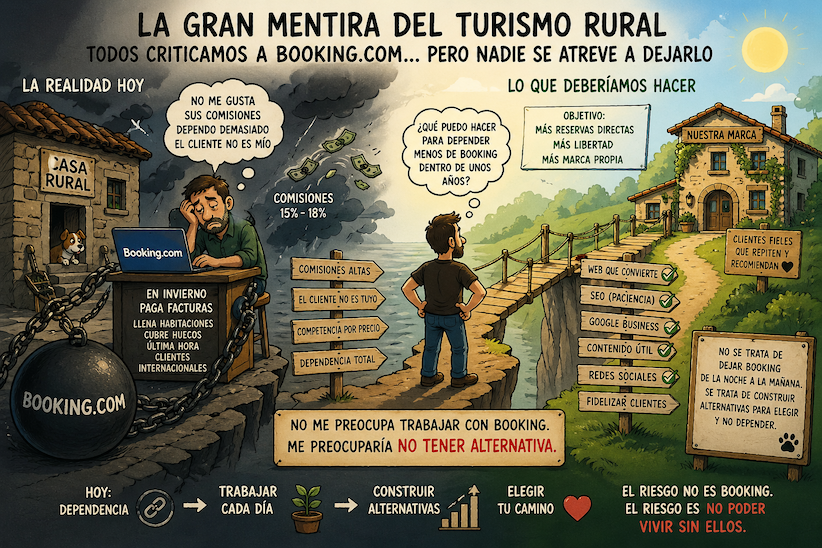
Yes, I criticise Booking.com… and I’m still using it
No, I’m not a hypocrite. It’s pure and simple survival.
Complaining about Booking.com while still working with them is not inconsistency. The real inconsistency would be keeping quiet, cashing the reservations and carrying on selling the pretty narrative of «direct bookings» without telling the truth.
And I know what some of you are thinking: «Hypocrite. Coward. He preaches one thing and does another.»
No. Complaining about something while still using it isn’t inconsistency. It’s honesty. The inconsistency would be staying silent. That would be the real posturing.
The real data: 6 years of bookings at Mas Torrencito
What I’m about to show you is not made up. These are my own figures, year by year, from 2021 to today. Real bookings. Real guests. Real commissions.
Note: these are Mas Torrencito’s numbers. My house, my figures, my reality. I have no idea whether your situation is better, worse or completely different. What I do know is that in my case, this is what happened.
Here is the full breakdown of where every booking came from at Mas Torrencito:
| Year | Direct (hotel) | Booking.com | Website | % Booking |
|---|---|---|---|---|
| 2021 | 457 | 84 | 116 | 11.6% |
| 2022 | 543 | 136 | 132 | 13.1% |
| 2023 | 629 | 252 | 97 | 24.2% |
| 2024 | 447 | 382 | 131 | 36.7% |
| 2025 | 409 | 284 | 206 | 29.7% |
| 2026* | 193 | 174 | 83 | 38.7% |
*2026: January–April data only. Source: Mas Torrencito internal management system.
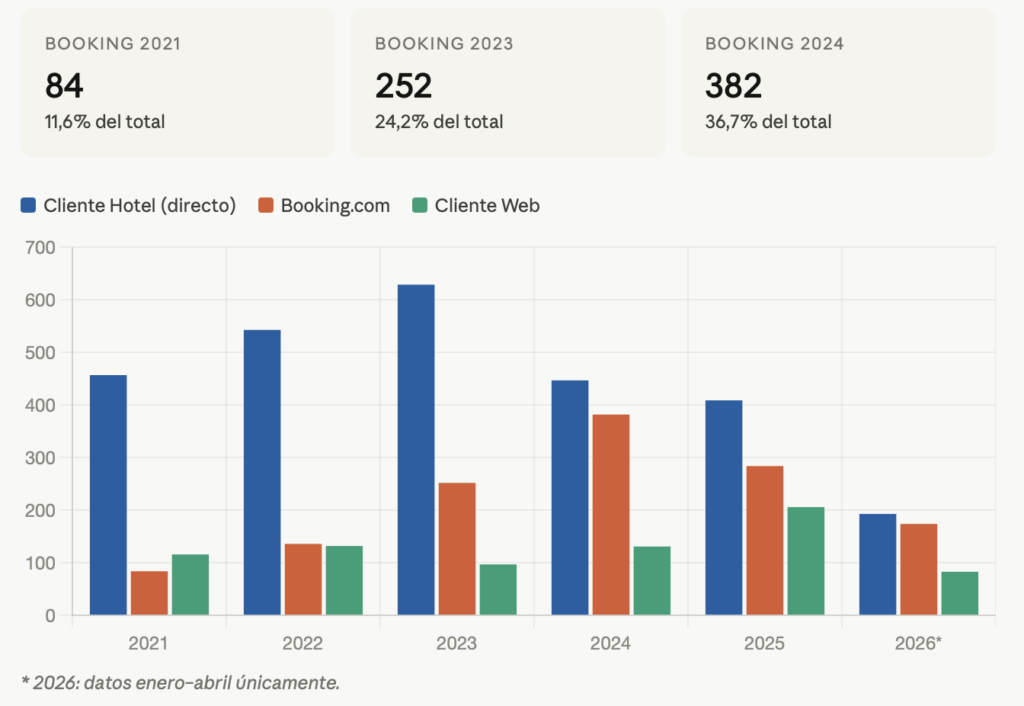
*2026: datos enero–abril. Fuente: gestión interna Mas Torrencito.
In 2021, Booking accounted for 11.6% of my bookings. By 2024 it had reached 36.7% — nearly 4 in every 10 guests arrived through them. That is exactly what worries me. Not the number. The trend.
The number I didn’t want to calculate
Since 2021, Booking.com has sent me around 1,300 bookings. Nearly €300,000 billed through their platform. So far, so good.
The problem is what I’ve paid them for it.
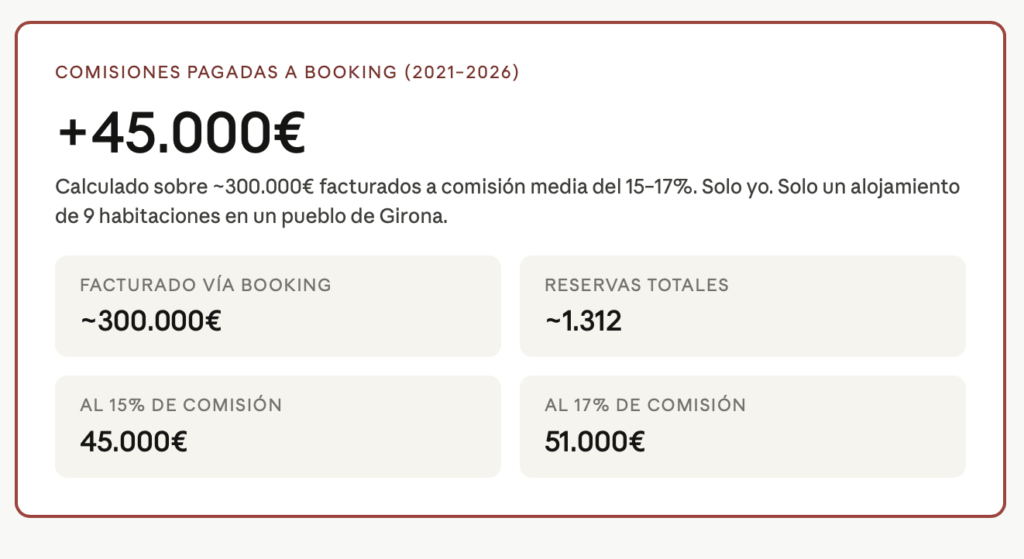
€45,000 minimum. Possibly over €50,000. Paid to a Dutch company that has never washed a single dish, made a single bed, or calmed down an anxious dog at 3 in the morning.
Can you imagine what I could have done with €50,000 invested in my own website, SEO, content, and guest loyalty? That’s the question that keeps me up at night.
Booking brings bookings, yes. But what quality?
There’s another reading that nobody talks about. Booking doesn’t just bring more reservations. It brings lower-quality reservations: shorter average stays, less loyalty, less return business.
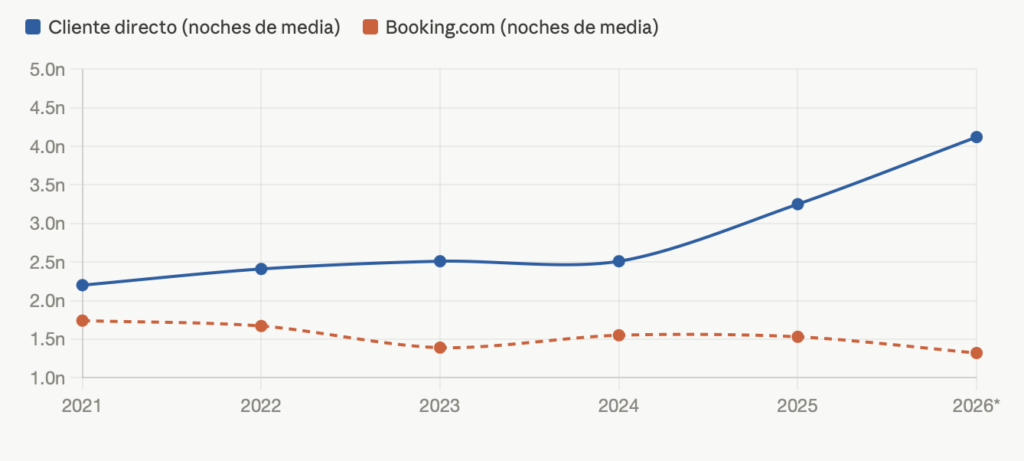
The guest who books directly stays 60–80% longer. Fewer turnovers, less work, more genuine connection. The Booking guest rarely comes back through the same door they arrived by.
A dependency that grows on its own
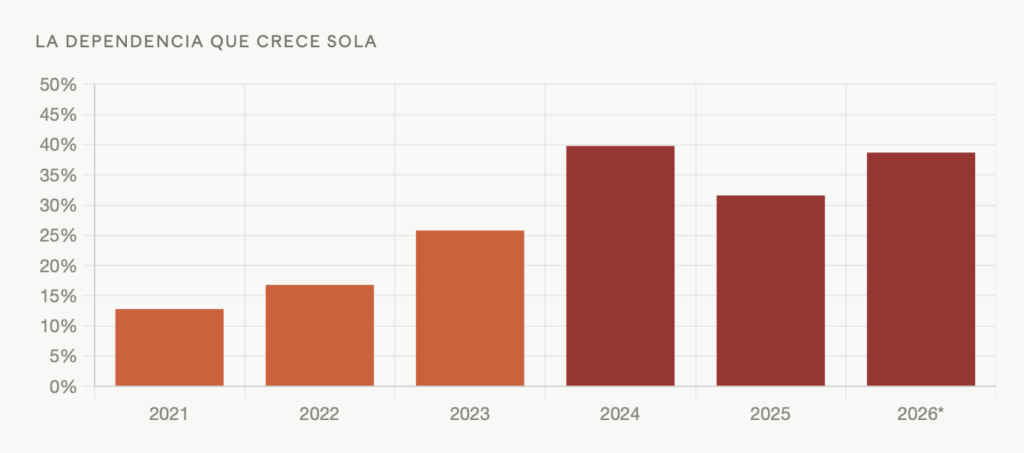
The dependency has tripled in 5 years. And that’s with all the direct booking work I’ve been doing. Imagine without it.
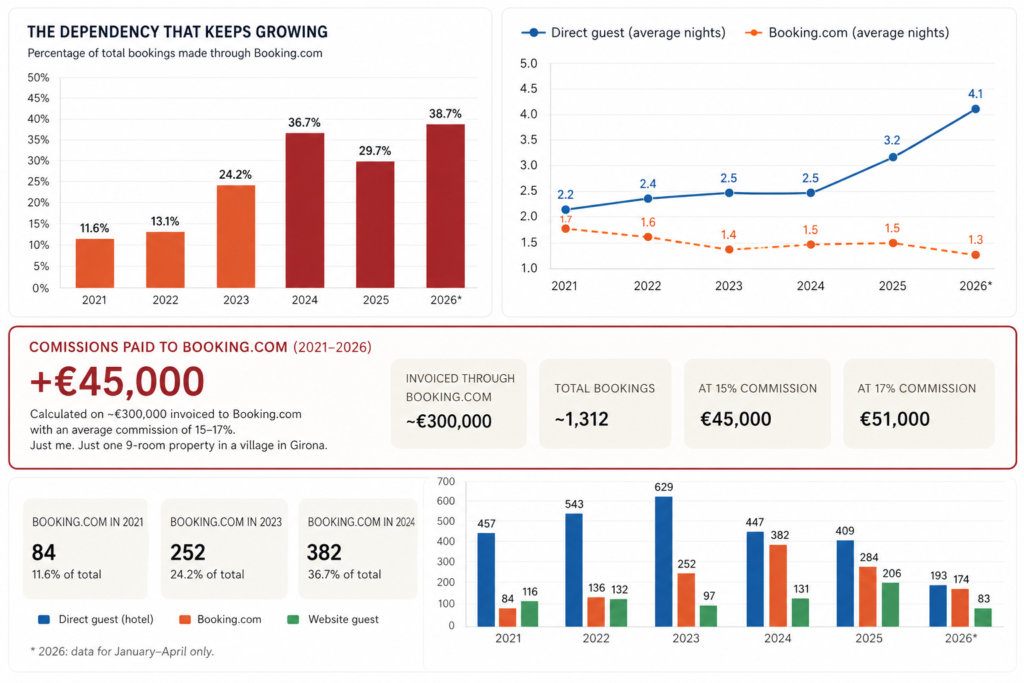
The truth nobody says out loud
In rural tourism there’s something we all know but few say openly:
- We all complain about commissions.
- We all champion direct bookings.
- We all hate depending on an OTA.
But then January arrives. Or February. Or any random Tuesday in November. And Booking saves the low season.
SEO doesn’t pay the electricity bill this week. Instagram doesn’t fill rooms overnight. And then a Booking reservation comes in… and you breathe again.
The problem isn’t using Booking. The problem is depending on it
Using Booking isn’t bad. Depending on Booking 100% is dangerous. Because when you’re completely dependent, you don’t set your own prices, you don’t choose your ideal guest, and you don’t control your future. You become a hostage.
The smart move isn’t to demonise Booking — it’s to build real alternatives: a website that actually converts, SEO built patiently over time, an optimised Google Business Profile, content that positions you, email marketing, loyal returning guests. None of this is fast. None of it is easy. But it’s the only thing that gives you real freedom.
The uncomfortable question
Are you doing anything concrete today to need Booking less in 2 or 3 years’ time?
Because the real risk isn’t that Booking kicks you off one day. The real risk is not being able to survive without them. And then you’re no longer the one making decisions.
Conclusion
I’ll keep working with Booking.com. With all their commissions and all their rules. Because right now it’s still a useful tool, especially in low season. What I won’t accept anymore is not having a plan B.
I’m not worried about working with Booking. I’d be worried about having no alternative.
Epilogue: the ones who got there first, won
Twenty years have passed. Twenty bloody years since Booking.com started embedding itself in our lives. And here we are in 2026, still depending on them just as much as day one.
It’s not that they’re smarter than us. It’s that they executed brilliantly. They slipped right past us while we were still thinking a roadside sign and a few nice photos was enough. They built a platform that’s fast, reliable, and — above all — makes guests feel safe. The traveller clicks a button and feels like everything is under control. Meanwhile, our rural website from 2008 still looked like a classified ad from the Yellow Pages.
As long as we keep complaining in WhatsApp groups without actually investing time or money in building our own alternative… in low season we’ll have no choice but to swallow it. Swallow 15–18% commissions. Swallow their rules. Swallow dependence on a company that isn’t ours.
Because guests don’t book out of principle. Guests book where it’s easy and where they feel safe. Full stop.
Are we going to spend another 20 years as hostages to whoever played the game best… or are we finally going to start playing too?
Frequently asked questions about Booking.com and rural tourism
Can you just leave Booking.com overnight?
For most rural accommodations, leaving Booking.com abruptly is not viable without a solid prior strategy. Years of built-up dependency mean that occupancy in low season drops sharply if no real alternative has been built for direct bookings first.
How much commission does Booking.com charge rural guesthouses?
Booking.com commissions for rural accommodation typically range from 15% to 18% of the booking value. Over 6 years and with €300,000 billed through the platform, the estimated cost exceeds €45,000 in commissions for a single 9-room property.
How can a rural accommodation reduce its dependency on Booking.com?
The most effective strategy combines long-term SEO, a website optimised for conversion, a well-maintained Google Business Profile, valuable content and loyal guest retention. It takes time, but it’s the only approach that creates genuine independence.
Is direct booking better than Booking.com?
Yes, in almost every way except immediate volume. Direct guests have an average stay 60–80% longer, lower acquisition cost, and are significantly more likely to return and recommend the property to others.enos coste de adquisición y tiene más probabilidades de repetir y recomendar el alojamiento.
_________
¿Viajas con perro?
Descubre por qué Mas Torrencito es una de las casas rurales petfriendly más auténticas de España.
🐾 Mas Torrencito
Turismo rural pet friendly en Girona
Donde los perros no pasan.
Se quedan.
🐾💛
Desde MasTorrencito te deseamos un buen día y que tus perros te acompañen!!!!
—–
Si quieres, puede ver nuestros bonos para fines de semana, bonos jubilados , a un precio increíble.. entra en www.mastorrencito.com
—-